
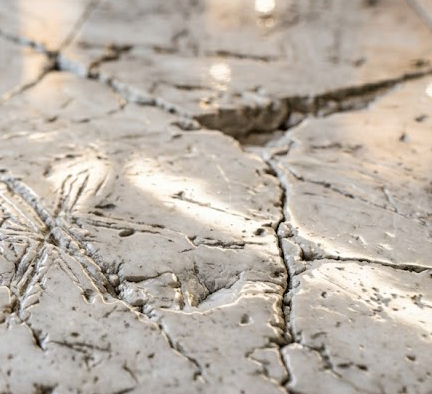
 Before grinding
Marble repair
Chips, cracks and stair nosings restored with tinted resin before levelling.
Lipping, deep scratches, traffic wear: we level your marble with diamond grits before polishing it.
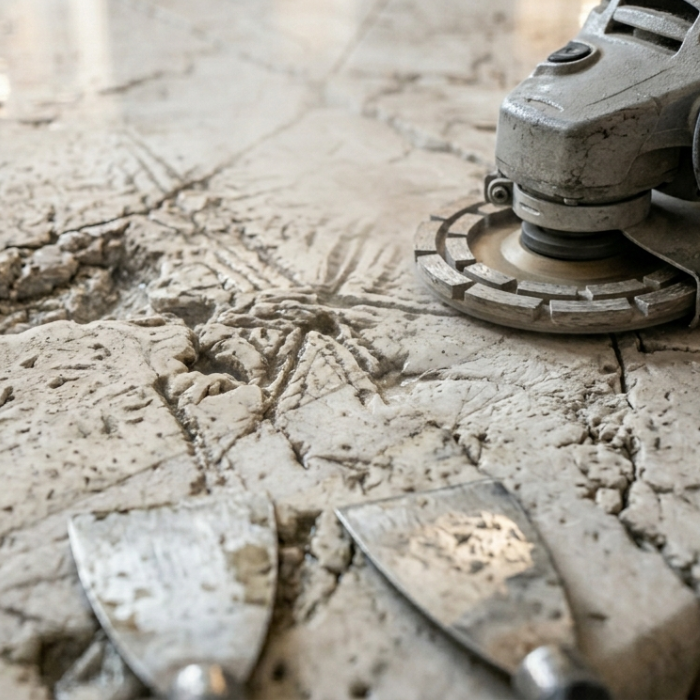
Marble grinding in Geneva is the stage that lets us start again from a sound, perfectly flat surface. It removes a very thin layer of stone to erase what time has worn in: deep scratches, wear paths in front of a door, tiles standing proud of one another, old marks left by harsh products.
It is groundwork, carried out with diamond abrasives fitted to a weighted machine. Done well, it is invisible: it simply prepares the stone so that the polishing that follows produces an even reflection, with no ripples or shadows.
Les Traitements du Sud · Geneva carries out this grinding in apartments, villas, PPE entrance halls, hotels and shops across the canton of Geneva and the Vaud lakeshore, always wet and with continuous residue extraction.
Grinding is the right answer when polishing alone can no longer restore an even surface.
When one tile stands a few tenths of a millimetre above its neighbour, every joint catches the light and sometimes the foot. This offset, known as lipping, comes from the original laying or from movement in the substrate. Grinding flattens the whole area so the floor becomes one continuous surface again.
Furniture dragged across, grit caught under a sole, chairs without pads: some scratches go too deep for polishing. Grinding goes down just far enough to remove them, then the following grits refine the surface.
In front of an entrance door, at the foot of a staircase or along a counter, foot traffic gradually wears dull hollows. Grinding brings these wear paths back level with the rest of the floor.
Acidic products, built-up old waxes or unsuitable treatments can leave an uneven surface. Grinding reaches the sound stone beneath, ready to be polished and protected.
Grinding starts with a diamond grit coarse enough to tackle the defects, then continues with ever-finer grits. Each pass removes the marks of the previous one. Choosing the starting grit is decisive: too fine and it will not correct lipping; too coarse and it would remove more material than necessary. We decide by looking at the depth of the defects and the nature of the marble.
The diamond discs are fitted to a weighted rotary machine whose weight and speed are set to work flat. Edges, corners, thresholds and steps are finished with a hand-held grinder using the same grit sequence, so that the whole surface is consistent right up to the skirting.
The work is done wet. Water cools the stone, extends the life of the abrasives and captures residue in a slurry that we vacuum up continuously. Neighbouring rooms stay clean, which makes it possible to grind in an occupied home or in the entrance hall of a lived-in building.
Marble is a relatively soft stone, so it grinds well, but it calls for restraint. We remove only the thickness needed, regularly checking flatness with a straightedge and under raking light.
We measure the lipping, locate scratches and worn areas, and provide a free quote in Swiss francs with the finish you are aiming for.
Furniture moved; skirting, doors and thresholds protected; access routes organised with you or the property manager.
Chips, holes and hollow joints are filled with tinted resin so they can be ground together with the stone.
Successive passes with coarse then medium diamond grits until the surface is perfectly flat and even.
Fine grits take over up to the chosen finish: matt, satin, gloss or mirror.
A protective impregnator can be applied, then the floor is cleaned and handed back with care advice.
Grinding is never an end in itself. A freshly ground surface is flat but still dull; it is polishing that restores its depth and colours. That is why we plan the two stages together from the very first visit.
If you want a satin floor for an apartment, the sequence stops earlier; for a mirror-polished lobby, it continues to very fine grits and then buffing. On a heavily used floor, crystallization can then reinforce the shine.
Finally, a water- and oil-repellent sealer applied to freshly polished stone makes the result last longer and simplifies everyday care.
In buildings along the nineteenth-century ring boulevards, in Florissant-Malagnou or in Eaux-Vives, many entrance halls and landings have been clad in marble for decades. Tiles may have shifted slightly, steps have worn down in the middle, and generations of cleaning products have left their mark. Grinding is the technique that gives these floors back their flatness and unity while keeping the original stone.
In the villas of Cologny, Vandœuvres or Collonge-Bellerive, there are often large continuous surfaces running between living room, hallway and covered terrace. Careful grinding erases the traces of an earlier renovation, blends in replaced tiles and restores a consistent floor from one end of the house to the other.
For marble staircases, grinding the treads and landings restores an even surface, while chipped stair nosings are handled through marble repair before being ground with the rest.
Before grindingChips, cracks and stair nosings restored with tinted resin before levelling.
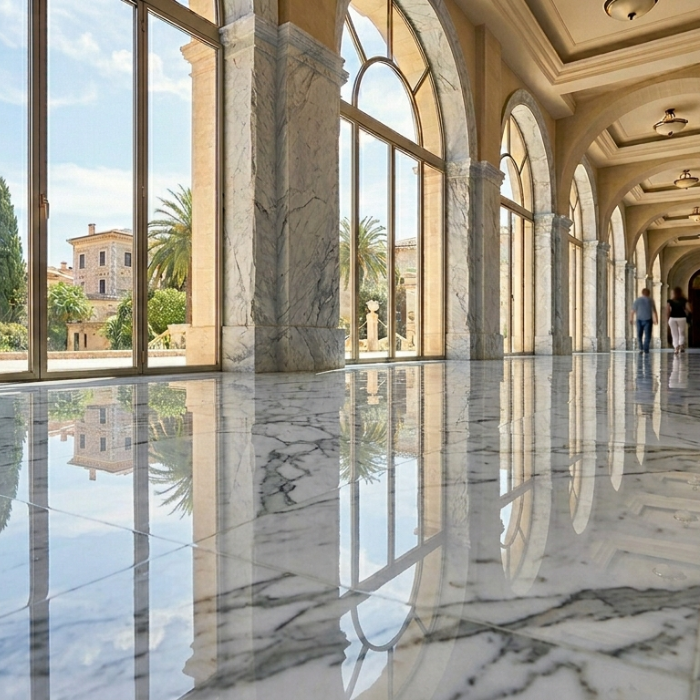 After grinding
Fine grits deliver the finish you want, from velvety matt to mirror polish.
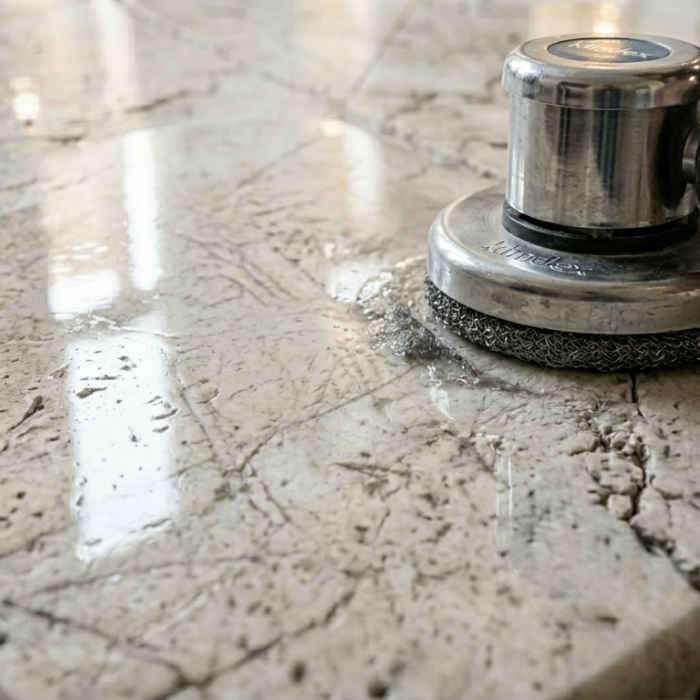 Enhanced shine
For lobbies and busy floors, a hardened, luminous surface.
Grinding becomes necessary when tiles show lipping, when scratches can be felt with a fingertip, or when wear paths have formed. Polishing alone would refine the surface without correcting these reliefs. If your marble is flat and simply dull, polishing is often enough. We tell you which approach is right during the free visit.
Lipping is the slight difference in height between two adjacent tiles. Even a few tenths of a millimetre shows up under raking light and can catch the soles of shoes. Grinding flattens the tiles into one continuous surface, which polishing then makes even and luminous.
No, we remove only the thickness needed to erase the defects, usually a fraction of a millimetre up to a few tenths depending on the lipping. The starting grit is chosen precisely and flatness is checked regularly. Marble of standard thickness can therefore be restored several times over its lifetime.
We grind wet: residue forms a fine slurry that is vacuumed up continuously, without clouds of dust. Skirting, doors and nearby furniture are protected, and the site is cleaned every evening. This method allows us to work in an occupied apartment or in a PPE entrance hall that remains in use.
Yes. Treads, risers and landings are ground with machines suited to small surfaces and finished by hand along the edges. Chipped nosings are first repaired with tinted resin, then ground with the rest. The staircase regains an even surface that matches the lobby floor.
It depends on the area, the extent of the lipping and the finish you want. A single apartment room can be done in a few days; a large lobby or villa takes longer. The free quote sets out the schedule, which we organise with you or the property manager to keep disruption to a minimum.
Send us a few photos and the approximate area: we will reply with a clear proposal in Swiss francs. Our contact page is at your disposal.