
 Surface
Building lobbies
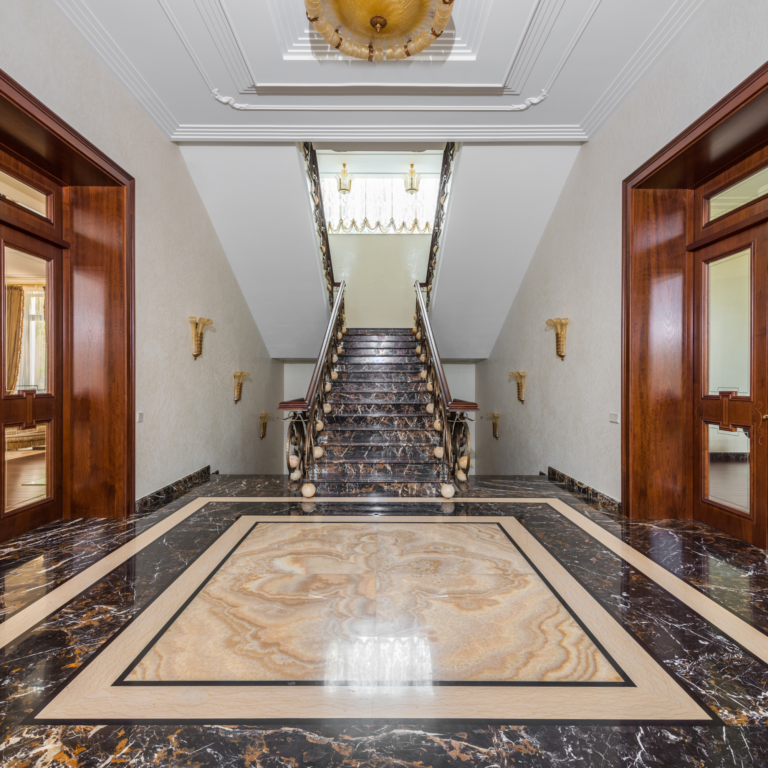
The lobby and shared staircase are often restored in one project for a continuous finish.
Treads, risers, landings, nosings and stringers restored step by step, with access maintained and a finish that feels secure underfoot.
A marble staircase is the hardest-working feature in any house or building. Every footstep lands in the same place, in the middle of the tread and on the nosing, so wear is concentrated into a few centimetres. That is where the polish goes first: edges soften, chips appear on the nosings, and the risers carry the marks of shoes and vacuum cleaners.
Restoring a marble staircase in Geneva therefore calls for a different approach from a floor. The surfaces are narrow, with many angles, so we use more compact machines and a great deal of hand finishing. The staircase also has to stay usable, because it is often the only way up to the upper floors.
Les Traitements du Sud · Geneva restores interior staircases in villas, feature staircases in duplex apartments and common stairwells in PPE buildings, from the Old Town to the lakeside communes. We cover the whole structure — treads, risers, landings, nosings and stringers — for an even result from the ground floor to the top landing.
A stone staircase combines horizontal surfaces, vertical surfaces and edges. They do not wear in the same way and are not restored with the same tools.
The walking surface concentrates wear in the centre. Flat grinding removes the worn dip and scratches, followed by polishing that blends the centre of the tread with its edges, which are often still intact.
Being vertical, risers take knocks from shoe tips and cleaning equipment. They are treated by hand or with small machines, taking care not to round off the angle where they meet the tread.
The front edge is the most exposed to chipping. We rebuild it with filler tinted to match the stone, then reshape the original profile — square, rounded or moulded — for a crisp line.
Landings are restored like small floors. They are also where the flight starts and ends, so their finish is matched to the treads for a seamless transition.
Marble stringers, running alongside the stairs against the wall or on the open side, pick up shoe polish, paint and scuff marks. They are cleaned and then hand-polished to match the shine of the treads.
Stepped skirtings and raking panels complete the structure. Cleaning and polishing them finishes the overall look of the stairwell.
In a villa or in an apartment building alike, a staircase cannot be closed for days on end. We therefore organise the work so that access is maintained at all times. The most common method is to treat every other step, then come back to the remaining ones once the first set has dried: people go up and down by stepping over the steps being worked on.
On a wide staircase we can also work half the width at a time, leaving a marked-out walkway along the handrail. In a building’s stairwell, we progress floor by floor and post notices on each landing showing which areas are in progress.
Grinding is done wet and the water is vacuumed up immediately, which prevents run-off onto the steps below. Warning tape and protection on banisters, walls and landing rugs complete the set-up.
We note the number of steps, their width, the type of marble, the condition of the nosings and risers, and the access that needs to be kept open. The free quotation is drawn up in Swiss francs.
Banisters, balusters, walls, rugs and skirtings are protected. The walkway is marked out and the circulation plan explained to occupants.
Chipped edges and cracks are filled using our marble repair method, then the nosing profile is recut.
Grinding removes worn dips and scratches step by step, alternating so the stairs stay in use.
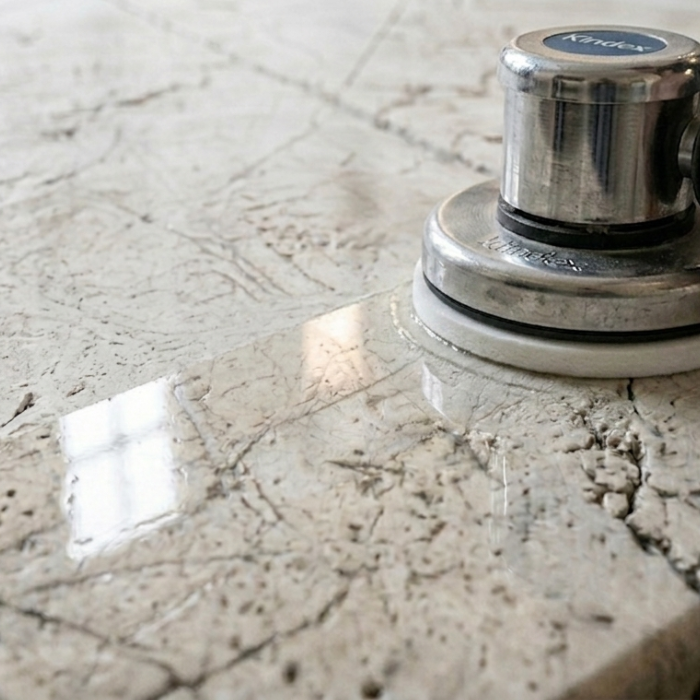
Polishing brings treads, risers and stringers to the level of shine agreed together.
A suitable finish on the treads, a discreet anti-slip treatment where needed, then a stain-resistant sealer.
On a staircase, the level of shine is also decided with grip in mind. Several approaches combine elegance and safety without adhesive strips or visible profiles.
The first is to choose a satin or honed finish on the treads while keeping a higher polish on the risers and stringers: the staircase keeps its glow and the walking surface offers better grip. The second is a colourless anti-slip treatment applied to the treads, which improves grip, particularly on slightly damp stone, while barely changing the look. We always test it first on a discreet area to agree the result with you.
For staircases in building entrances, where melted snow and de-icing salt come in with residents in winter, these choices matter all the more. A generous entrance mat at the foot of the stairs completes the arrangement.
In villas in Cologny, Vandœuvres or Collonge-Bellerive, the staircase is often the centrepiece of the entrance hall, with solid treads, sometimes cantilevered, and a wrought-iron or timber balustrade. The aim there is a refined finish that works with the hall floor.
In buildings in the Old Town, on the nineteenth-century ring boulevards or in Champel, the shared staircase serves every floor and follows the rhythm of residents’ lives. Restoration is planned with the régie or the PPE committee: notices for residents, working hours and floor-by-floor progress. Our page for property managers and PPEs sets out this organisation in detail.
Where the staircase opens onto a marble lobby, we can treat both together for a perfectly continuous finish, from the building’s threshold to the top landing.
Steps get dirtiest in the centre and against the riser, where the vacuum cleaner reaches less easily. Regular dusting, washing with a lightly diluted pH-neutral cleaner and rinsing with clean water are enough. Avoid waxes, which make steps slippery, and limescale removers, which are too harsh for marble.
In a busy building, periodic maintenance — buffing the treads, checking the sealer and anti-slip treatment — keeps the staircase looking its best without a full regrind. On a staircase that is simply dull, crystallisation of the treads can restore the shine between two restorations.
SurfaceThe lobby and shared staircase are often restored in one project for a continuous finish.
 Service
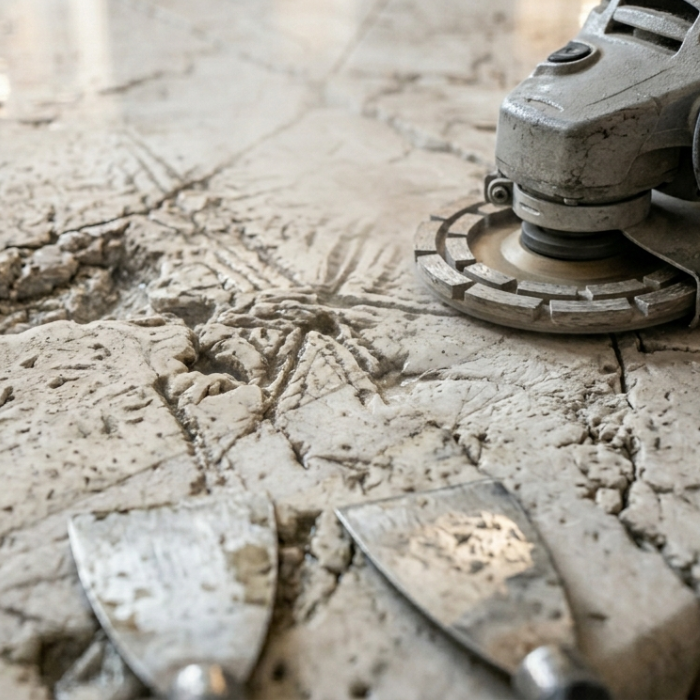
The stage that removes worn dips and scratches on treads and landings.
 Service
Chips, broken nosings, cracks: rebuilt with filler tinted right through.
Yes. We work on every other step or on half the width at a time, marking out the walkway, so the staircase remains usable throughout. In a building’s stairwell, we progress floor by floor and keep residents informed with notices. Only the steps being finished need to be stepped over, and only for a few hours.
In most cases, yes. The chip is cleaned, filled with filler tinted to the colour of the marble, then reshaped and polished to recover the original profile of the edge. The repair blends into the stone and stands up to foot traffic. A step cracked right through is assessed separately during the visit.
Polish alone does not make a staircase dangerous when it is clean and dry, but we tailor the finish to the use. On the treads, a satin or honed finish and, if needed, a colourless anti-slip treatment improve grip without changing the look. We always test the result on a discreet area before applying it.
It depends on the number of steps, their width, the condition of the nosings and the access method chosen. A single-storey villa staircase is usually completed in a few days; a multi-storey stairwell in an apartment building takes longer. The precise timescale is set out in the free quotation provided after the visit.
It is strongly recommended for an even result: freshly polished treads next to dull risers create a visible contrast. Risers and stringers need less grinding than the treads, often a deep clean and hand polishing. The quotation itemises each part so you can decide what to include.
Yes. We work with régies and PPE committees in Geneva: an itemised quotation in Swiss francs for the general meeting, notices for residents, working hours that fit the life of the building and floor-by-floor progress. The entrance lobby can be included in the same project for a continuous finish.
We work in all the communes listed below. For a project, write to us through the contact page with the number of steps and a few photos.
Number of steps, width, condition of the nosings: send us a few photos and we will arrange a visit for a free quotation in Swiss francs.