
 Surface
Marble floors
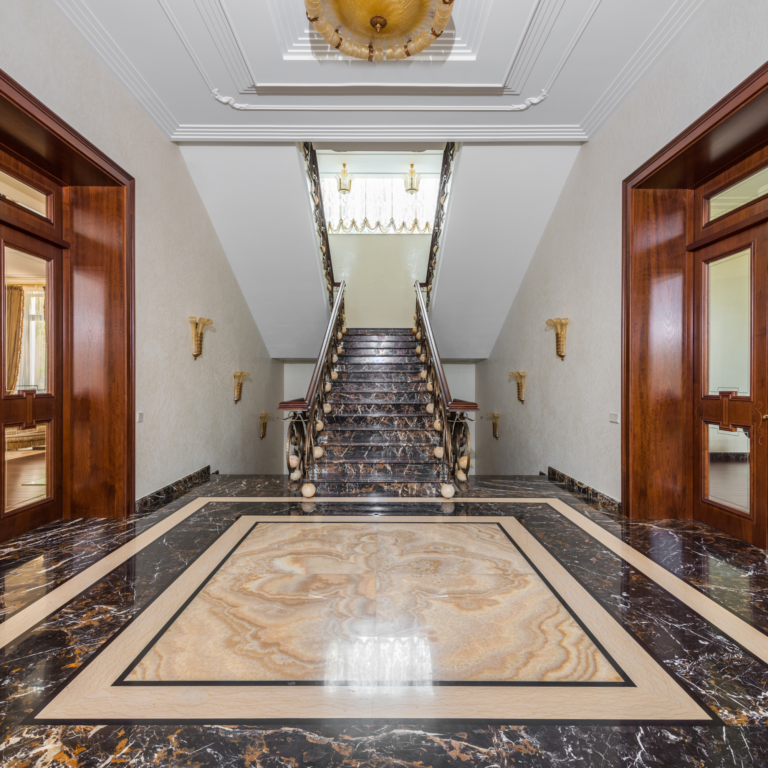
Living rooms, entrances and large areas brought back to life, tile by tile.
Visit and free quote, sample-area trial, grinding and polishing, protection, care advice: five clear steps for every job.
Every marble has its own story: a nineteenth-century lobby on the ring boulevards, a contemporary bathroom in Champel, a grand staircase in a manor house in Cologny, a boutique on the Corraterie. Our marble restoration method in Geneva starts from that observation: stone is not restored by a fixed recipe. We observe it, test it, then choose the right techniques.
The method unfolds in five steps, always in the same order. It gives you visibility at every point of the job: you know what will be done, why, how long it will take and what result to expect. It applies just as well to a small coffee table as to several hundred square metres of hotel flooring.
Les Traitements du Sud · Geneva brings this expertise to the whole canton of Geneva and the Vaud shore, for private clients, property managers and PPE co-ownerships, hotels, banks, boutiques and interior designers.
We come to see the stone on site: type of marble, finish, surface condition, scratches, stains, chips, joints, access and constraints of the premises. You then receive a free, detailed quote in Swiss francs.
On a small area chosen with you, we carry out the planned treatment. You see the real result before the full job begins.
The surface is worked grit by grit, wet, up to the approved finish: mirror gloss, satin or soft honed.
An impregnator suited to the room’s use protects the stone from stains, with no surface film.
We hand over the right routine and suitable products and, if you wish, a periodic maintenance programme.
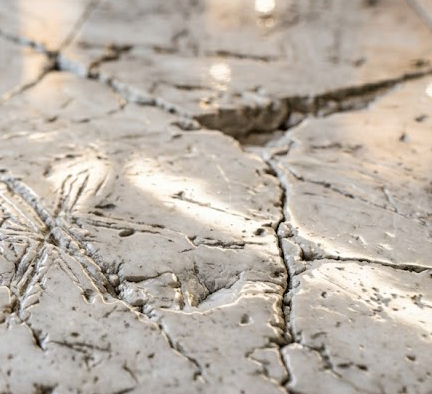
The visit is where everything is decided. We identify the marble (Carrara, Calacatta, Emperador, Bardiglio, green marbles and more), its original finish and the nature of each defect. A surface scratch, acid etching, an absorbed stain and traffic wear are not treated in the same way. We examine the surface under raking light and check the flatness of the tiles and the condition of the joints.
We also take stock of the premises: floor level, lift, power and water supply, furniture to move, possible working hours. In a residential building we note the caretaker’s requirements and the PPE regulations.
The quote, free of charge, is drawn up in Swiss francs. It details the surfaces, the services selected (grinding, polishing, repair, stain removal, protection), the expected duration and how the job will be organised.
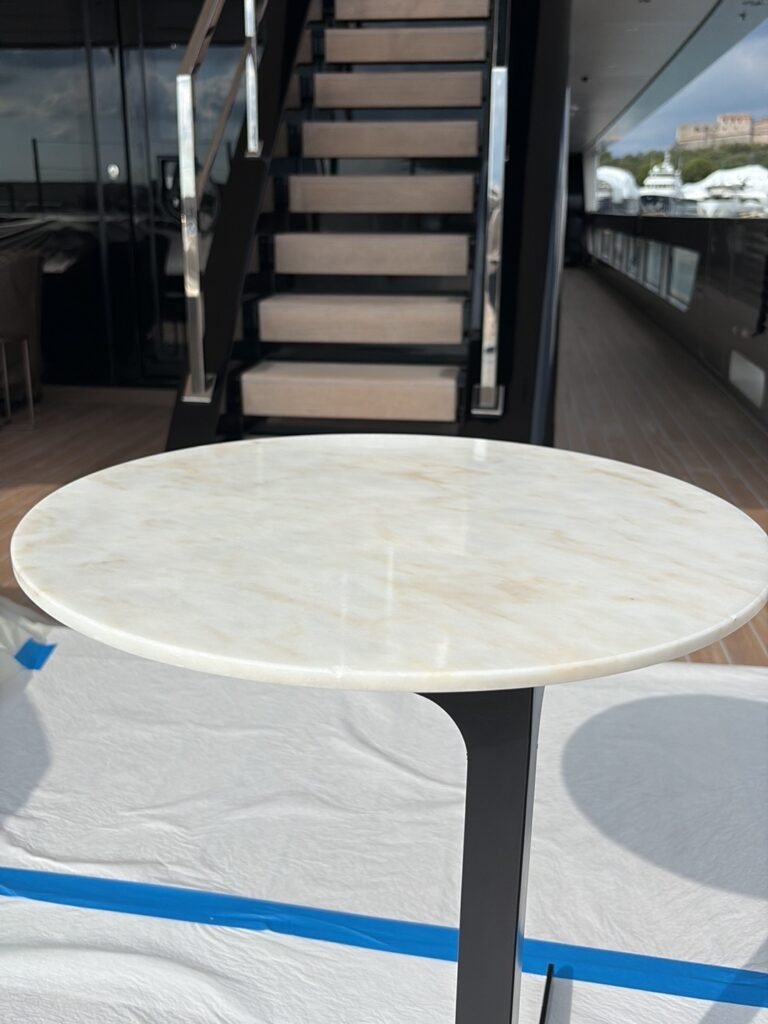
No two marbles react in exactly the same way. Before starting the job, we carry out the complete treatment on an area of roughly one square metre, chosen to be representative: a worn walkway, a typical stain, or a discreet corner for a precious marble.
The trial confirms three things: the level of grinding required, the finish you prefer (gloss, satin or honed) and how the stone responds to the protective products. It is also an excellent decision-making tool for a PPE general meeting or an interior designer who needs a finish signed off.
The core of the job is done with a single-disc machine or a grinder, using diamond discs whose grit becomes progressively finer. Grinding removes scratches, acid etching and lippage between tiles; polishing then closes the surface up to the chosen finish.
We work wet. Water cools the tools, binds the fine stone particles and stops dust from spreading through the home or building. The grinding slurry is vacuumed up as we go, and the surface rinsed between each grit. On very busy floors, crystallisation can complete the polishing.
Marble restoration often takes place in occupied homes or spaces open to the public. Organisation matters as much as technique.
Before any work begins, we protect skirting boards, wall bases, doors, woodwork and any furniture that cannot be moved, using suitable films and tapes. Thresholds to adjoining rooms are sealed off so that water and slurry stay within the work area.
In a lobby or stairwell, we work zone by zone so that residents can always get through. Notices inform occupants of dates and times. We avoid the morning and evening rush and respect the quiet hours set by the building rules.
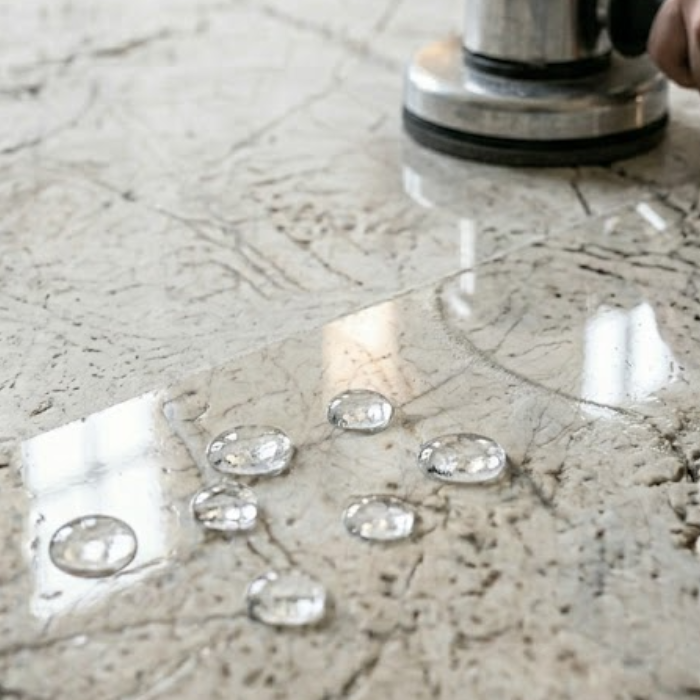
Once the stone is dry, we apply water- and oil-repellent protection suited to the room: reinforced stain protection for a kitchen, water-repellent for a bathroom, a deep-penetrating impregnator for a lobby exposed to winter salt. The product penetrates the stone without forming a film, preserves the finish achieved and lets the marble breathe.
A water and oil drop test at the end of application confirms the protection is effective, and we tell you how long to wait before normal use.
Restored marble keeps its lustre far longer when it is looked after properly. At the end of the job we give you simple guidance: a pH-neutral soap for natural stone, a well-wrung microfibre cloth, wiping up acidic liquids quickly, using coasters and felt pads under furniture, and entrance mats in winter.
We also tell you which products to avoid, such as vinegar, descalers or multi-surface cleaners, and how often the protection should be renewed depending on how the room is used.
For property managers, PPE co-ownerships, hotels and retailers, this fifth step can continue as a marble maintenance contract with periodic buffing: the stone then stays in the condition it was in on handover day.
Whatever the size of the project, the same rigour applies from the first appointment to handover.
SurfaceLiving rooms, entrances and large areas brought back to life, tile by tile.
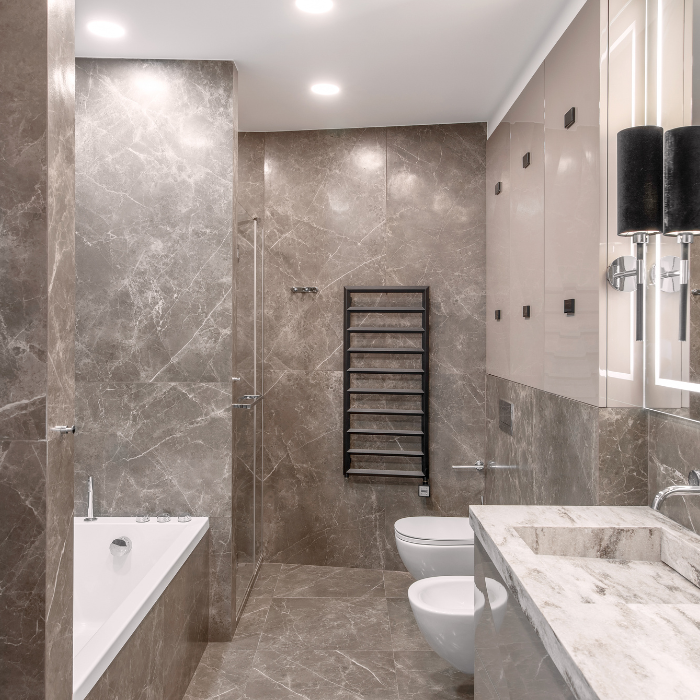 Surface
Basins, showers and cladding descaled, re-polished and protected.
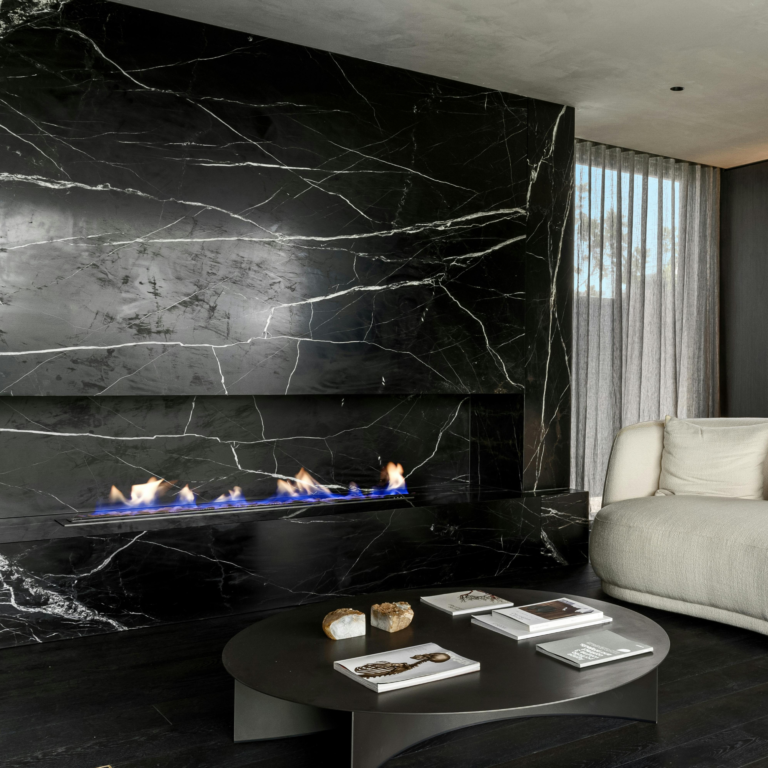 Surface
Mantels and hearths cleaned, repaired and revived with care.
Yes. We travel throughout the canton of Geneva and the Vaud shore to examine the stone and take measurements, with no obligation. You then receive a detailed quote in Swiss francs setting out the surfaces, services, duration and organisation of the job.
It shows you the real result on your own marble before you commit to the whole surface. It also lets us fine-tune the level of grinding, the finish and the protective product. For a PPE or an architect, it provides a concrete reference for getting the finish approved.
Very little, because we work wet. Water binds the stone particles into a slurry that is vacuumed up as we go. Surrounding areas are protected with film and thresholds sealed off, which means we can work in a furnished apartment or a building lobby that remains in use.
Yes. We divide the lobby into zones treated one after another, with a marked walkway always available for residents. Working hours are agreed with the property manager and caretaker, and notices keep occupants informed. The site is left clean every evening.
It depends on the surface area, the condition of the stone and the services chosen. A bathroom or worktop is often done in a day, a building lobby in a few days. The expected duration is stated in the quote, including drying time before protection.
A polished floor can be walked on soon after it has dried. The protection then needs a few hours before light use and up to 72 hours for full effectiveness. We confirm these times at the end of the job, along with when the first wash can take place.
Tell us about your marble and your project via our contact page: we will arrange a visit and send you a free quote in Swiss francs.