
 Guide
Removing stains from marble
Removing stains from marble: grease, wine, rust, limescale and acid etching. What you can safely do yourself and when to call in a marble…
The right everyday habits, pH-neutral products and precautions against de-icing salt to keep your marble looking its best.
Marble is a metamorphic limestone: dense, refined and capable of lasting for centuries, yet sensitive to three well-known things — abrasion from grains of sand, acids and overly aggressive products. With proper care, a marble floor keeps its lustre for many years between two restorations.
This guide brings together the everyday routines our craftsmen recommend, how to choose the right products, and the precautions specific to a Geneva winter, when de-icing salt and grit are carried into lobbies and flats. It is written for homeowners as much as for caretakers and property managers looking after common areas.
The aim is simple: preserve the existing finish, whether polished, honed or matt, and space out major work for as long as possible.
The first enemy of a marble floor is not the stain, it is sand. Every grain carried in on a shoe acts like very fine sandpaper: with repeated footfall it scratches the surface and dulls the polish, especially in high-traffic areas such as entrances, corridors and the space in front of a sink or kitchen island. Routine care is therefore first about removing particles before they are walked in.
Use a dry dust mop, a microfibre pad or a vacuum cleaner fitted with a soft brush. Avoid hard wheels and plastic attachments that can mark the stone. In residential lobbies, a daily pass makes a real difference.
A well-wrung microfibre mop and a few drops of a cleaner designed for natural stone are all you need. Change the water as soon as it turns cloudy so you are not spreading dirt back across the floor.
Anyone living in Geneva or Vaud knows the tap water is fairly hard. On dark, polished marble, drying with a clean microfibre cloth prevents limescale rings and streaks.
Wine, citrus juice, vinegar, coffee: blot without rubbing using kitchen paper, then wipe with a damp cloth. The faster you act, the less time the liquid has to soak in or attack the surface.
Felt pads under chair and table legs, rugs at key walkways, coasters on marble furniture: small accessories that prevent a great many scratches.
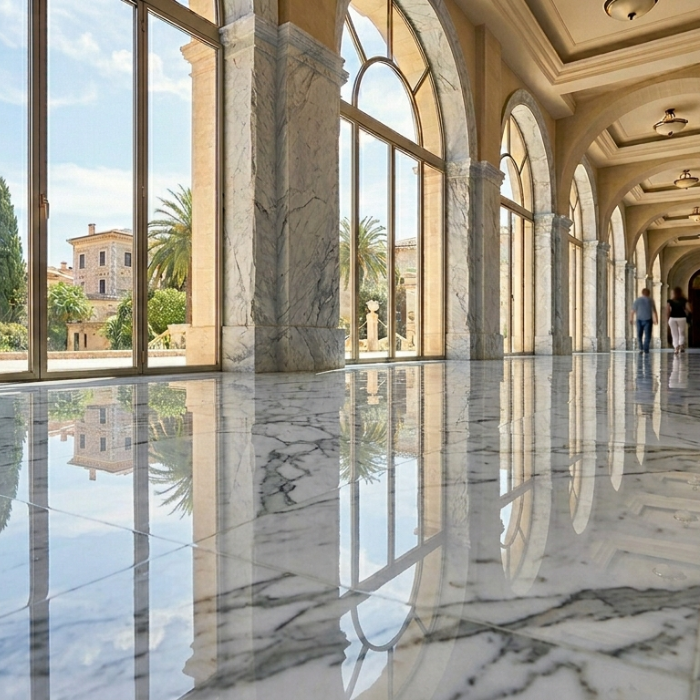
Marble is made mostly of calcium carbonate. When it comes into contact with an acid, even a diluted one, it reacts chemically: the surface dissolves very slightly and leaves a dull mark, often called etching. It is not dirt you can wash away; it is damage to the polish itself.
A pH-neutral cleaner (around 7) cleans without attacking. Conversely, strongly alkaline products used repeatedly can, over time, break down some protective treatments and leave a dull film.
Read the labels: “suitable for natural stone / marble” is a good indicator. If your floor has been treated with a water or oil repellent, ask your marble specialist which cleaner is compatible with the protection applied.
From December to March, Geneva’s pavements are regularly treated with salt and grit. These residues find their way into lobbies and hallways on the soles of shoes. Grit scratches; salt leaves whitish deposits as it dries and, if it penetrates stone that is not sufficiently protected, can recrystallise in the pores and cause minor surface damage.
The answer is mostly preventive. A large scraper mat outside, followed by an absorbent mat inside, traps most of the residue. In an apartment building, it is worth agreeing with the caretaker on more frequent sweeping during snowy spells, and washing with clean water and a neutral cleaner to dissolve salt deposits before they dry.
At the end of winter, a thorough clean is the moment to take stock: if the lobby has lost its shine or shows persistent whitish haze, professional maintenance with buffing or a light crystallization usually restores the original lustre.
Two mats: a scraper outside, an absorbent one inside. Shake and vacuum them often; they only work while they stay clean.
Daily sweeping of lobbies and landings, and a wash with lukewarm water and neutral cleaner as soon as white marks appear.
A full clean and a check of the finish. This is the right time to schedule maintenance or renew a protective treatment.
A well-protected marble floor is easier to clean and resists greasy marks and coloured liquids better. Water- and oil-repellent treatments penetrate the stone without forming a film: they reduce absorption without changing its appearance. Their effectiveness gradually wears off with time and washing, which is why they should be renewed according to the manufacturer’s recommendations and how heavily the floor is used.
On high-traffic floors — residential lobbies, shop entrances, hotel receptions — periodic professional maintenance (buffing, maintenance crystallization) keeps the shine and delays the point at which full grinding becomes worthwhile. Find out more on our marble maintenance page and our marble sealing and protection services.
Once wear has set in (scratches visible against the light, dull walkways, tired joints), a full restoration with marble polishing brings back an even surface. Our page on marble floor restoration explains the options depending on the condition of your stone.
In a home, dusting daily or every other day and washing weekly with a pH-neutral cleaner suits most floors. In a residential lobby or a shop, sweeping should ideally be daily and washing adapted to footfall. What matters most is removing sand before it scratches the surface, rather than washing with large amounts of water more often.
Black soap is slightly alkaline and can be used highly diluted on some stones, but regular use tends to leave a film that dulls polished marble. A cleaner formulated for natural stone with a neutral pH remains the safest choice, particularly on a polished finish or a floor that has been treated with a protective product.
As Geneva’s water is fairly hard, it is often enough to wring the mop out more thoroughly and dry the floor with a clean microfibre cloth, especially on dark marble. If haze persists, never reach for a limescale remover: ask a marble specialist, who will suggest a solution that is safe for the stone.
When the floor has lost its shine despite proper care, when scratches or dull marks appear, or when walkways stand out clearly from the rest of the surface. A professional assesses the stone and recommends the right treatment, from simple buffing to full restoration. The quote is free and given in Swiss francs.
Our craftsmen assess your floor and recommend the right maintenance or restoration. Request your free quote, provided in Swiss francs.
GuideRemoving stains from marble: grease, wine, rust, limescale and acid etching. What you can safely do yourself and when to call in a marble…
 Guide
Marble polishing or crystallization: how each works, results, time on site and the criteria for deciding which technique suits your floor or worktop.
 Guide
Marble restoration cost per m²: area, condition of the stone, finish, access and working hours. Understand your quote, free and given in Swiss francs.