
 Guide
Caring for marble floors
Caring for marble floors: daily habits, pH-neutral products, pitfalls to avoid and precautions against de-icing salt during a Geneva winter.

Two techniques for restoring the shine of marble: how they work, their strengths and the criteria for choosing the right one.
When marble has lost its shine, two words keep coming up in quotes: polishing and crystallization. Both aim for a glossy surface, but they work in entirely different ways and suit different situations.
Polishing is mechanical work: a very thin layer of stone is removed with progressively finer diamond abrasives until the desired level of finish is reached. Crystallization is a surface treatment: a specific product, worked in with a rotary floor machine, reacts with the calcium carbonate in the marble and hardens the top layer, giving it a glossy appearance.
This guide compares the two approaches point by point to help you understand what your floor, staircase or worktop really needs, and to read a quote with confidence.
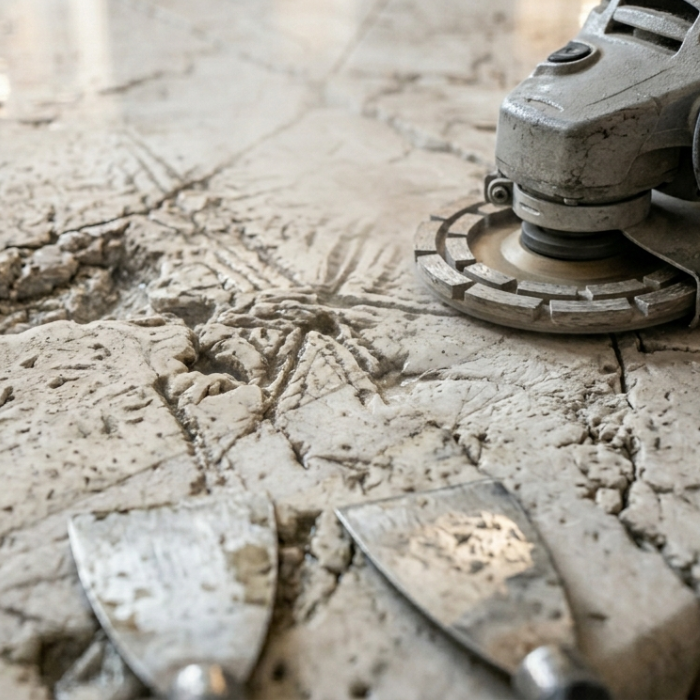
Polishing is carried out with a machine fitted with diamond discs. Depending on the condition of the stone, the craftsman starts with a coarser or finer grit (grinding, when the surface needs levelling or deep scratches removing), then works through progressively finer grits. Each pass removes the micro-scratches left by the previous one.
The process can stop at different stages: a honed finish (matt or satin) or a mirror polish. This is what makes polishing so versatile: you choose the final look, and it is consistent across the whole surface.
It is the right answer when marble shows visible scratches, widespread etching, dull walkways or uneven joints between tiles, or when you want to change the finish.
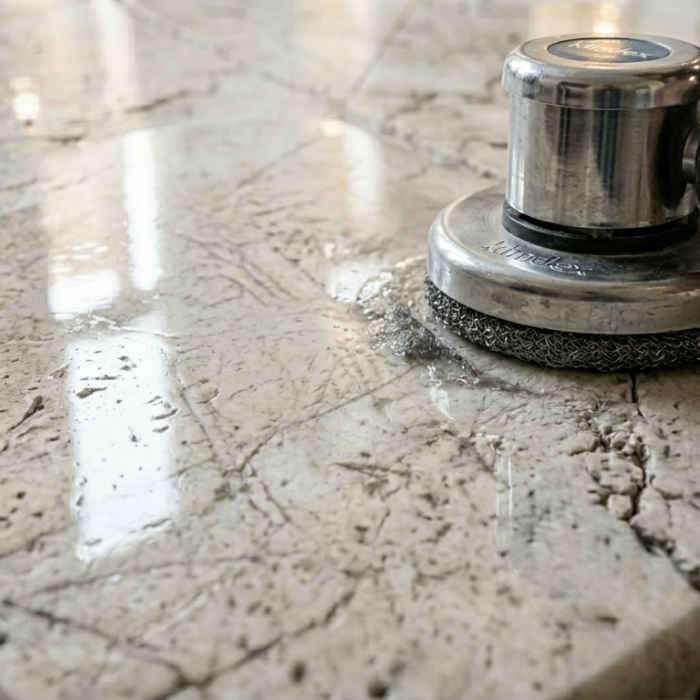
Crystallization uses a salt-based product (usually fluorosilicates) sprayed onto the stone and worked in with a rotary machine fitted with a steel-wool pad. Heat and friction trigger a reaction with the calcium carbonate in the marble: the top layer is transformed, becomes harder and takes on a beautiful shine.
The treatment removes no material, so it does not eliminate deep scratches or unevenness. On the other hand, it is quick, can often be done without closing an area for long, and gives a bright result on marble in good condition.
It is suitable for calcareous stones (marbles and some polished limestones) and fits naturally into a periodic maintenance programme for high-traffic surfaces.
The right choice depends above all on the condition of the stone and the result you expect. Here are the criteria our craftsmen look at.
Deep scratches, etching, uneven tiles: polishing is the answer. A surface simply dulled by use: crystallization is often enough to revive the shine.
Polishing lets you choose between matt, satin and mirror. Crystallization gives a glossy look; it is not designed for a matt result.
Crystallization is quick and can often be scheduled outside working hours. Full polishing, in several passes, takes longer and requires access to be planned.
Crystallization works on calcareous stones. Diamond polishing adapts to every marble, including heavily veined or coloured varieties.
Residential lobby, reception, shop: maintenance crystallization extends the effect of polishing. A home with light footfall: a well-executed polish lasts a long time.
The two complement each other very well: polishing to bring the stone back to level, then periodic crystallization to maintain the shine.
Before any quote, a marble specialist examines the stone under low-angle light, identifies scratches, dull areas and unevenness, then determines the type of marble. This visual assessment points towards one technique, the other, or a combination of both.
Low-angle light, a touch test on dull areas, locating scratches and etching.
Mirror gloss, satin or matt: the desired finish largely determines the method.
Footfall, possible working hours, access constraints: a residential lobby is not organised like a private bathroom.
Polishing, crystallization or both in sequence, with protection applied at the end if needed.
A suitable maintenance schedule keeps the result looking its best for longer.
To see each technique in detail, visit our marble polishing and marble crystallization pages. If the stone shows more pronounced defects, the marble grinding page explains how a surface is levelled before being repolished.
It reduces the appearance of fine surface scratches by restoring shine, but it does not remove any material. Deep scratches, chips and marked etching remain visible. To make them disappear, polishing is needed, or even grinding first if the surface is badly damaged.
Technically, crystallization produces a glossy finish, so it would change the look of matt marble. If you want to keep a honed finish, polishing stopped at the corresponding grit with suitable protection is the better option. Your marble specialist can show you the difference on a small area if needed.
Polishing works the stone in depth and its result is durable, especially in a home. Crystallization, being more superficial, wears with footfall and is renewed according to traffic. That is why initial polishing is often combined with maintenance crystallization in busy spaces.
Not in most cases, but the area being treated must be kept clear. In a residential lobby, the work is often organised half at a time or outside normal hours to keep access open. The free quote, in Swiss francs, sets out the expected duration and organisation.
Our craftsmen assess your stone and recommend the most suitable method. Request your free quote in Swiss francs.
GuideCaring for marble floors: daily habits, pH-neutral products, pitfalls to avoid and precautions against de-icing salt during a Geneva winter.
 Guide
Removing stains from marble: grease, wine, rust, limescale and acid etching. What you can safely do yourself and when to call in a marble…
 Guide
Marble restoration cost per m²: area, condition of the stone, finish, access and working hours. Understand your quote, free and given in Swiss francs.